Pausha Masa: The Winter Months of the Barahmasa Paintings

A formal exploration of the visual poetics in the Barahmasa miniature painting genre and what they tell us about winter rituals practised in India.
Arising from its roots in the aesthetics of poetry, Barahmasa is a topic abundantly explored in Indian court paintings. The word Barahmasa literally translates to twelve months. The literature and art arising from this genre outline narratives – usually tales of lovers featuring themes of union and separation – spanning twelve months. Specific attention is given to each month’s attributes, that correspond with the changing Indian seasons. Some examples highlight the vibrant blossoms for spring or dark grey skies and lightning for monsoons. Usually, these atmospheric details support certain archetypal figures; a couple engaging in loving exchanges and surrounding figures carrying out season-appropriate tasks (Figure 1). Given the romantic nature of this genre, it was thoroughly enjoyed across royal courts and painters were often commissioned to create scenes inspired by corresponding poetry.

Keshavdas, a pioneering scholar from the 16th century, is a great example showcasing the correlation between Indian poetry and court paintings. He was a celebrated writer, working across North and Central Indian royal courts. Forgoing formalised styles, Keshavdas chose to write in Braj Basa, a vernacular spoken by the common people. Parallel to the exponential rise of the Bhakti movement, his poetry was assimilated into the Indian court painting tradition with great ease. Art historian, B.N. Goswamy points out that the text featured on top of these paintings is meant to give ‘words to the visuals’ [1]. The illustrated manuscripts transform into storybooks. The poetic combination of text and painting not only narrates a saga but also serves as a documentary record of the lives of ordinary people.
As 2023 rushes to its end, it was appropriate to focus on the month of Pausha, the wintry season corresponding with the Gregorian calendar months of December-January. The two paintings in the British Museum collection (Figure 2 & Figure 3) include Keshavdas’ Pausha Masa (Pausha month) text, but their varying handwriting made it difficult to read certain phrases. So, I took it upon myself to track down and translate Keshavdas’ poetry to better explore the visuals. It reads as follows:
शीतल, जल, थल, बसन, असन, शीतल अनरोचक।
केशवदास अकास अवनि शीतल असुमोचक।।
तेल, तूल, तामोल, तपन, तापन, नव नारी।
राजा रंक सब छोड़ि करत इनही अधिकारी।।
लघुद्योस दीह रजनी रवन होत दुसह दुख रूसमें।
यह मन क्रम बचन बिचारि पिय पथ न बूझिय पुसमे।। [2]
In the winter, cold water, ground, clothes, and food are not liked.
Keshavdas says that from the skies to the ground, everything is wet like tears.
Oil, cotton, betel leaves, warmth from the sun, fire, and a new woman –
From a king to a beggar, people forsake all and swear by these things.
As days shorten and nights lengthen, there is unbearable pain in quarrelling.
Using your mind, efforts and speech, think upon my uttered words. O beloved, do not undertake the journey in the winter month.

One can see how each painter takes inspiration from this poem and breathes life into it. In Figure 2, we observe a scene composed much like traditional miniature paintings. The vermillion sun illuminates the frame with its remaining light before giving way to the growing blue sky. The grass is yellow and beginning to collect dew, a sight familiar to anyone who has experienced Indian winters. Sprigs of pink hibiscus flowers reaching skywards amongst other perennial trees frame a white building complex which makes up the foreground of the painting. The overwhelming variety of perspectives allows the viewer to be omnipresent. Our eyes are first drawn to the left, towards a couple sitting on the rooftop. Here we see a nayika (heroine) and a blue-skinned man sitting on a rooftop and smiling gently at each other. The blue-skinned man is Krishna, a human manifestation of Vishnu, the Supreme Preserver of this Cosmos. It is common practice for Indian court painters to seamlessly weave gods and goddesses into such artworks. Krishna is a court-favourite figure; his popularity is attested by his consistent appearance in court paintings over centuries.

The nayika offers a betel leaf to Krishna – chewing betel leaves in winter yields bodily warmth. The couple are opulently dressed in multiple layers of textiles. As our eyes bounce off the patterns on their clothing, we notice how every floor in each building is covered with brightly coloured carpets. On the right, a turbaned man dressed in orange garments massages oil onto the body of another man. Oil massages are a common practice to keep warm in the winter months – a tradition relevant even today. Notice the presence of diyas or oil lamps in the wall niche behind the seated figures. We also see two men, wrapped snugly in shawls, sitting around a fire in the open courtyard.

One can unmistakably match Keshavdas’ poetic descriptions to the elements that constitute the compositions of these Rajasthani court paintings. In Figure 3, we see another warmly dressed couple on the top right, but this time they are sitting by a brightly lit fire. On the right, inside the building, we see a very recognizable and relatable winter ritual! A reclining woman, completely wrapped in a green blanket like a cocoon. Observe how the direction of the golden motifs on her green blanket mirrors the motifs on the yellow bedspread; almost absorbing the woman into the sheets. Perhaps she longs for her lover’s presence and decides to find comfort in the cosiness of her bed. Like the previous painting, the scenes below depict a turbaned man massaging oil into Krishna’s body while two figures covered in shawls wait outside with a bejewelled crown.
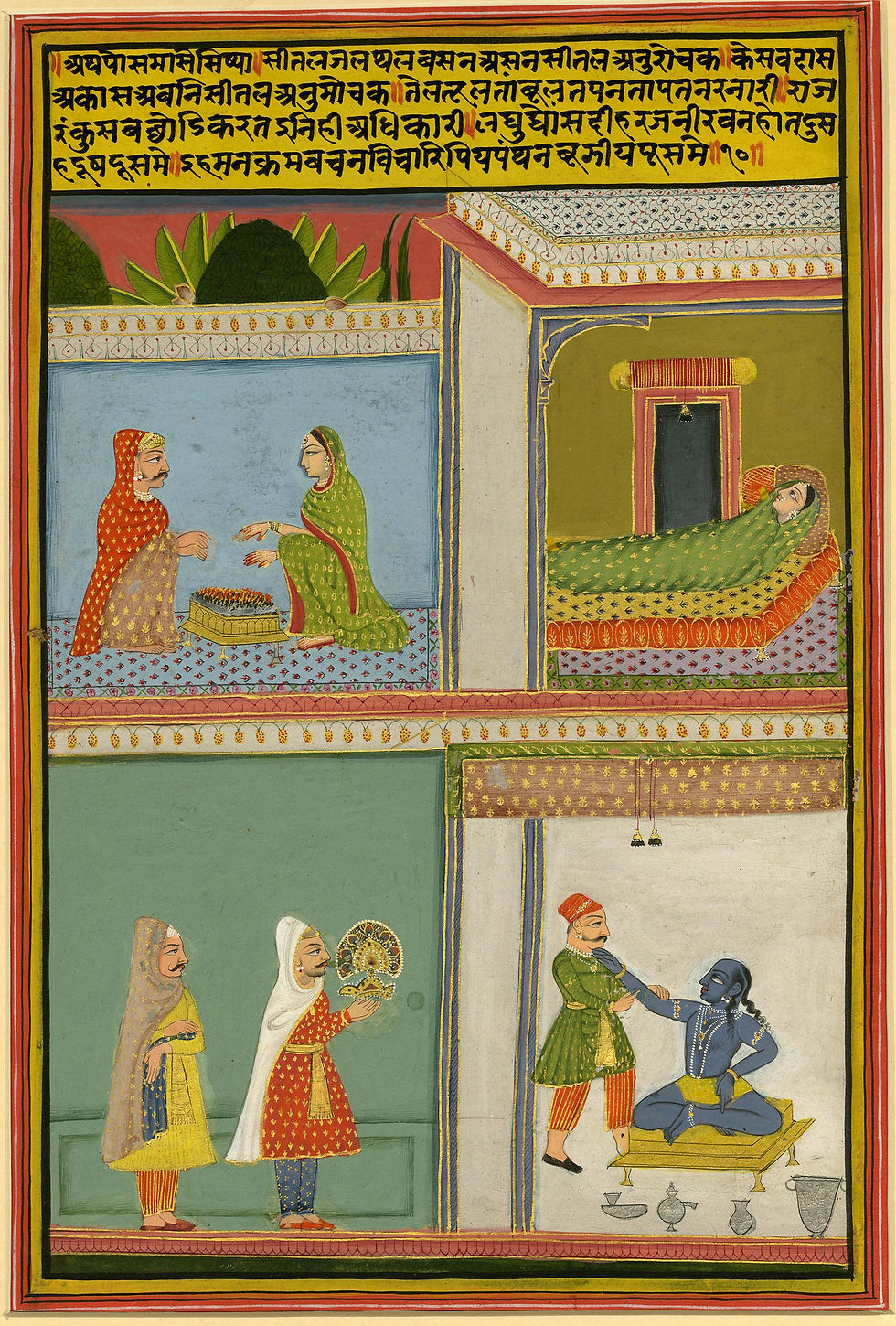
Figure 4 presents a different scene, throwing light on the versatility and artistic license practised within the Barahmasa genre. The painter chooses to depict the winter cold through an ordinary scene. Two women sit inside a building around a small metal box containing burning wood. They extend their hands above the heater to warm themselves while another woman approaches from outside. All three women are snugly wrapped in shawls that cover their entire bodies. The painting is labelled with the simple text, ‘Masa – Pausha’ in Devanagari and Nastalik scripts. This banal scene captures a moment of friendly solitude shared between these women on a wintry day.

Indian court paintings are a vibrant mixture of documentation, inspiration from poetry and religious iconography, combining to form a genre that remains timelessly intriguing. Wondrous compositions where the human manifestations of god, like Krishna in this case, are seen practising common seasonal rituals. This gives these paintings a divine enjoyable touch while maintaining their position as poetic-historical records of seasonal rituals. Many of these practices, like eating betel leaves and oiling your body are carried out in many, if not all, Indian households on cold, wintery days, even today.
Endnotes:
B.N. Goswamy, ‘Ch 75 Raga Vasanta’, The Spirit of Indian Painting: Close Encounters with 101 Great Works 1100 -1900, Thames and Hudson Ltd; Illustrated edition, 29 February 2016.
Mahakavi Keshavdas, ‘Poos-Vargan’, Kavi-Priya, pp. 169, Matri-Bhasha-Mandir, Prayag, India, 1966.
Republished from University of Birmingham's Department of Art History, Curating and Visual Studies Blog, Golovine: https://thegolovine.wordpress.com/2023/12/21/pausha-masa-the-winter-months-of-the-barahmasa-paintings/


Comments